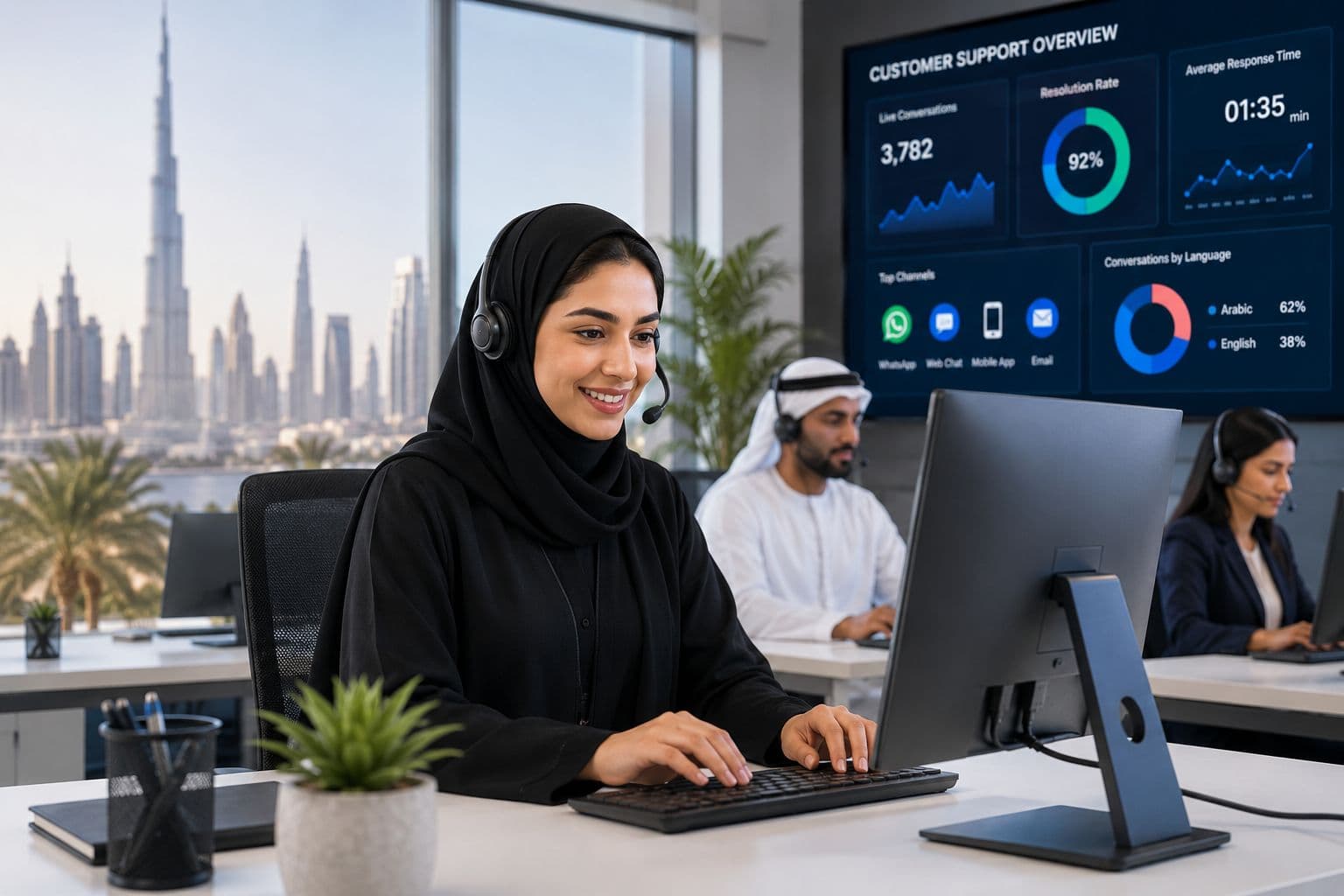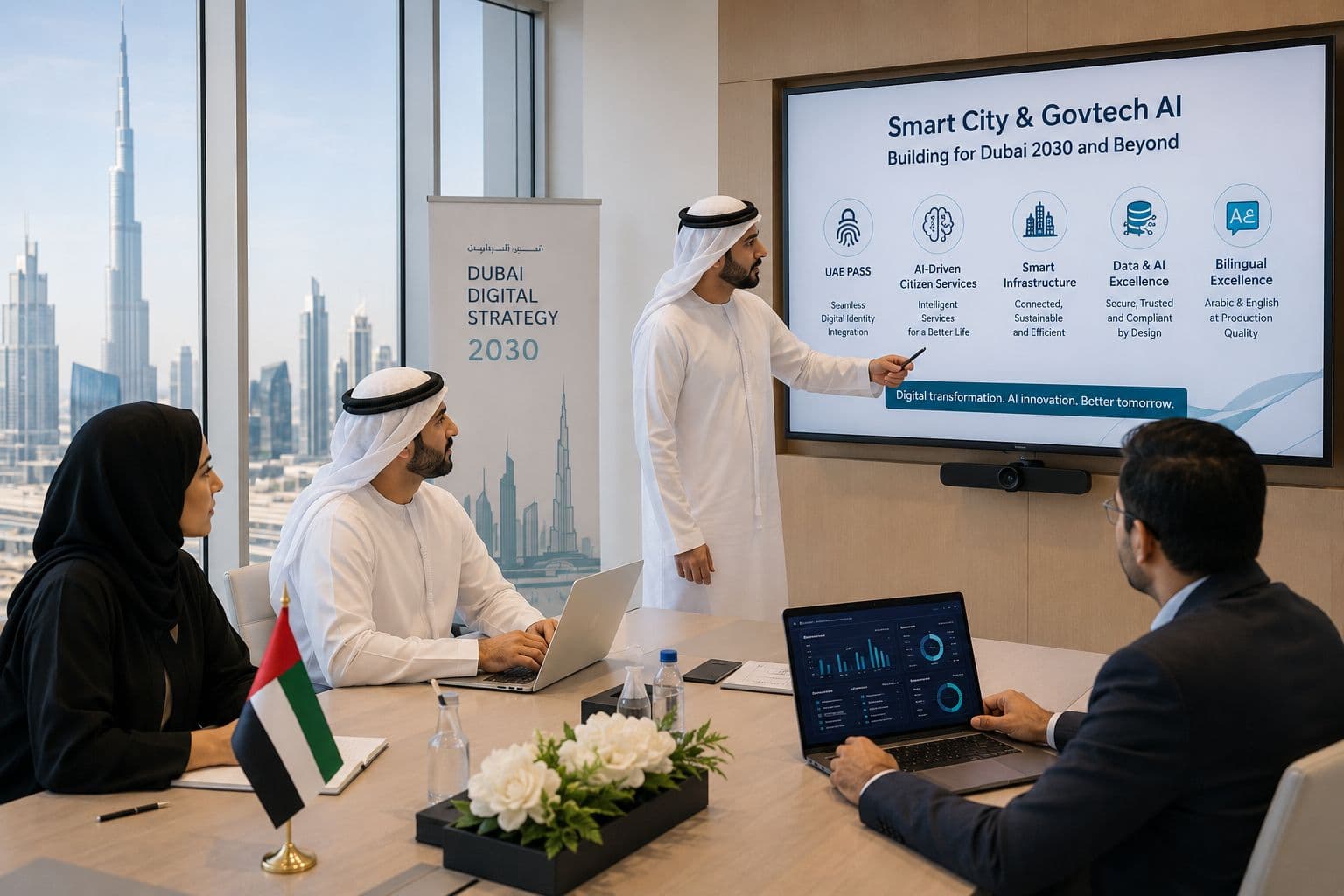
Bilingual delivery for the UAE is rarely a translation problem. It is a design problem that touches every layer of the application, UX, content, AI behavior, testing, and operations.
Most teams approaching UAE government work for the first time underestimate this. They assume Arabic is English with translation. They learn, usually during the first quality review, that it is not. This article walks through what bilingual Arabic-English delivery at production quality actually requires.
Right-to-left as a first-class design concern
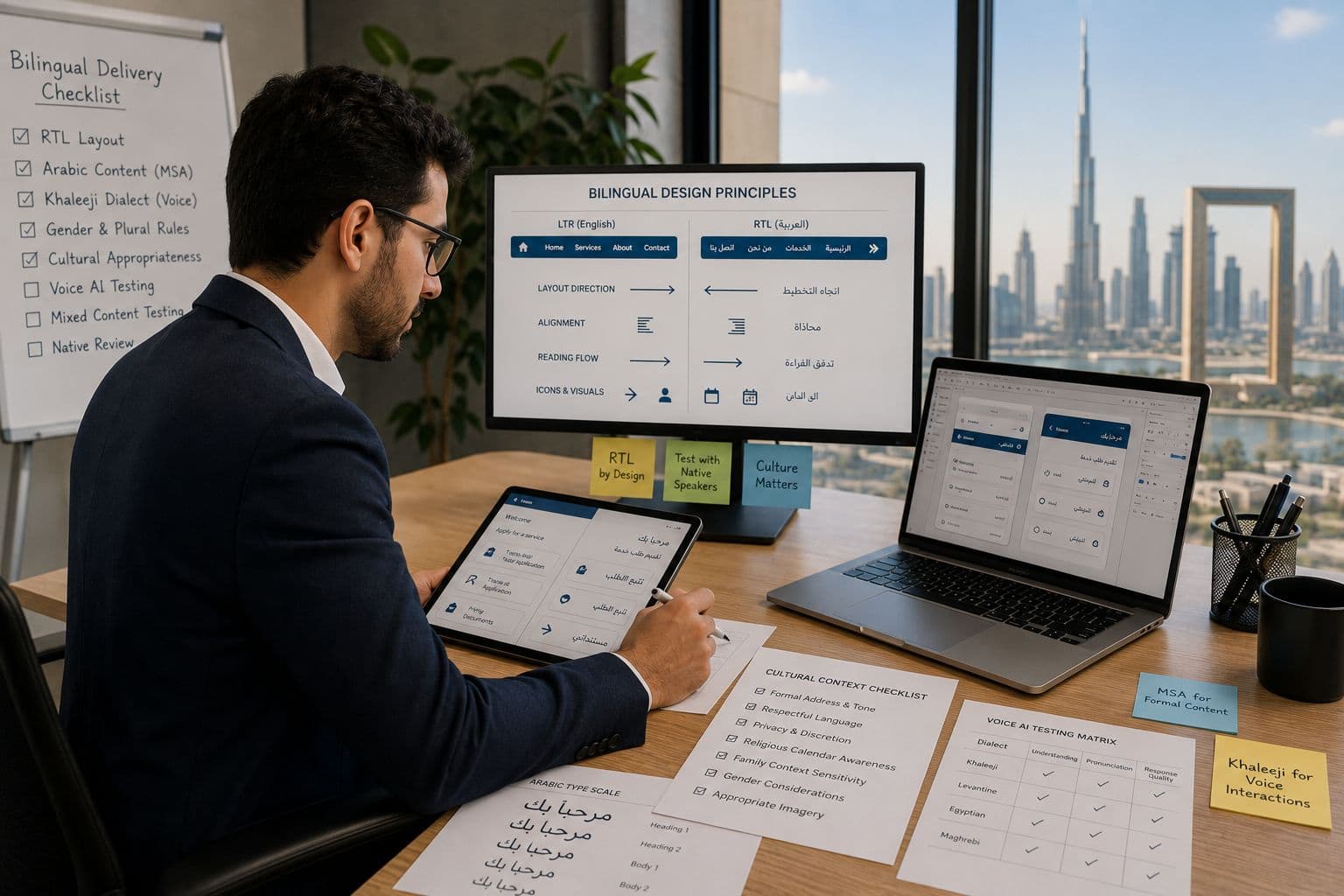
Arabic is read right-to-left. This affects every UI element, text alignment, form layout, navigation menus, button placement, breadcrumb direction, dropdown opening direction, modal positioning, chart legend placement, icon directionality.
Designing for RTL from the start is straightforward. Retrofitting an LTR design to RTL is painful and produces visible defects. Common defects in retrofit work, form fields misaligned with their labels, icons that imply forward-motion pointing the wrong way for the RTL reading direction, charts where the legend and axis ordering contradict the script direction, modal close buttons in unintuitive positions for RTL users.
Bilingual designs that work need a unified design language that handles RTL natively, mirrors layouts cleanly between LTR and RTL, and handles mixed Arabic-English content (very common in UAE professional contexts) without breaking either direction.
Modern Standard Arabic versus Khaleeji dialect
Arabic is diglossic, there is a difference between the formal written language (Modern Standard Arabic, MSA) and the spoken dialects used in different parts of the Arab world. In the UAE, the local spoken dialect is Khaleeji (Gulf) Arabic, with influences from Levantine, Egyptian, and other regional varieties.
MSA is used for formal written content, government communications, news, formal speech, documentation. Khaleeji is used for spoken conversation, casual interactions, and increasingly for voice interfaces aimed at UAE citizens.
For AI systems, this distinction matters. A government chatbot communicating in writing should use MSA. A voice assistant for UAE citizens needs to understand Khaleeji inputs and may need to respond in either MSA or a register that bridges MSA and Khaleeji depending on context. AI systems that try to use MSA for spoken interactions feel stilted; AI systems that use Khaleeji for written formal content feel inappropriate.
Gender, plurals, and morphology
Arabic morphology is complex relative to English. Verbs change for gender, number (singular, dual, plural), and person. Nouns have masculine and feminine forms and dual forms. Adjectives agree with the noun they modify. Verbs in past, present, and imperative tenses have specific gendered forms.
AI features that generate Arabic content need to handle this correctly. A message that addresses a female user with masculine-gendered verbs reads as broken. A message that says "two items" using the plural form rather than the dual form reads as broken. AI systems generating Arabic need testing methodology that specifically validates morphological correctness, English-only QA processes will not catch these defects.
Voice AI in Arabic
Arabic voice AI has improved significantly through 2024-2025 but remains harder than English voice AI for two reasons. Phonetic complexity, Arabic has phonemes that don't appear in English, including emphatic consonants and pharyngeal sounds that distinguish meaning. Dialect variation, voice input from a UAE national, an Egyptian expat, and a Levantine expat may all be valid for the same service, and the system needs to handle the variation.
Voice AI for UAE government services needs evaluation on these dimensions, pronunciation handling for emphatic and pharyngeal phonemes, dialect tolerance across Khaleeji, Levantine, Egyptian, and Maghrebi varieties, and graceful failure when input falls outside the model's coverage.
Cultural context in citizen interactions
Citizen interactions in UAE government contexts have cultural conventions that AI systems need to respect:
● Formal address, citizens addressed with appropriate honorifics and formality registers, not casual Western-style first-name address
● Respect markers, interactions begin and end with culturally appropriate phrasing, not direct task-only exchanges
● Family considerations, many administrative matters involve family context (custody, inheritance, beneficiaries) that AI systems need to handle sensitively
● Religious calendar awareness, Ramadan, Eid, Hajj, and other religious observances affect service availability expectations, response timing, and content tone
● Privacy expectations around topics, marriage status, financial matters, health matters are handled with particular discretion, not openly volunteered
● Gender considerations in service design, some services may have specific design considerations around gender appropriateness in image use, content tone, or service flow
Testing methodology
Production-quality bilingual delivery requires testing methodology that catches Arabic-specific defects. Recommended practice:
● Native Arabic-speaking testers involved from design phase through production release, not only at final acceptance
● Specific test cases for morphological correctness, gender, number, tense, across the content surface
● Voice AI testing across the dialect range relevant to the UAE user base, Khaleeji at minimum, ideally Khaleeji plus Levantine plus Egyptian
● RTL layout testing as a dedicated test suite, not as an afterthought to LTR testing
● Cultural appropriateness review for citizen-facing content by reviewers familiar with UAE government conventions
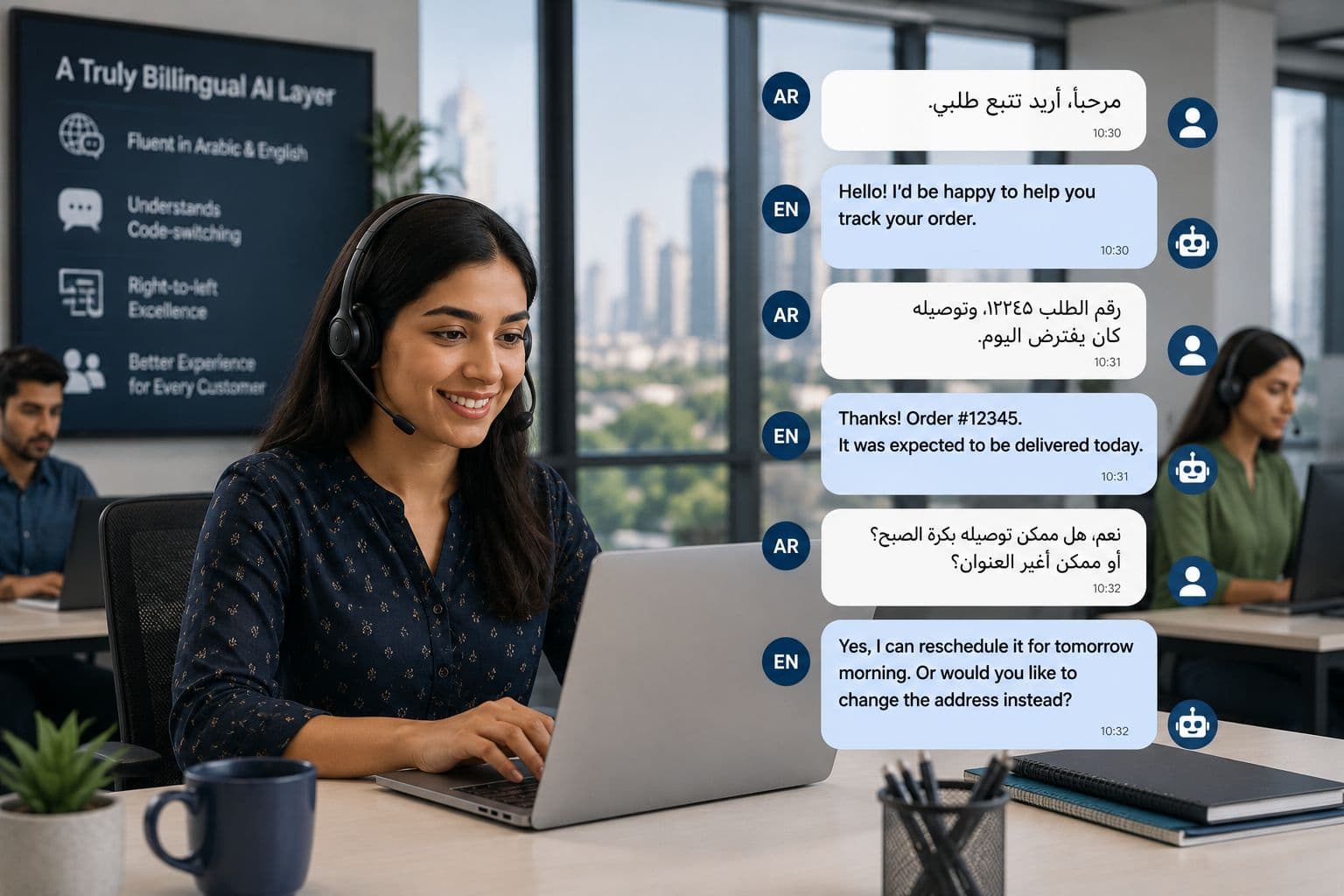
● Bilingual mixed-content testing for the realistic case of users switching between Arabic and English mid-conversation
The shift to make
Stop treating Arabic delivery as a translation activity that happens after the product is built in English.
Start treating bilingual Arabic-English delivery as a design constraint from the beginning of the engagement, RTL-first design, MSA-versus-Khaleeji choices made deliberately, morphological correctness tested explicitly, cultural context operationalized, native Arabic speakers embedded in the delivery team from day one.
Partners that build this capability earn structural credibility for UAE government work that translation-only partners cannot match. Partners that don't build it get caught at quality review and lose engagements they technically had the capability to deliver, because the bilingual layer never reached production quality.