
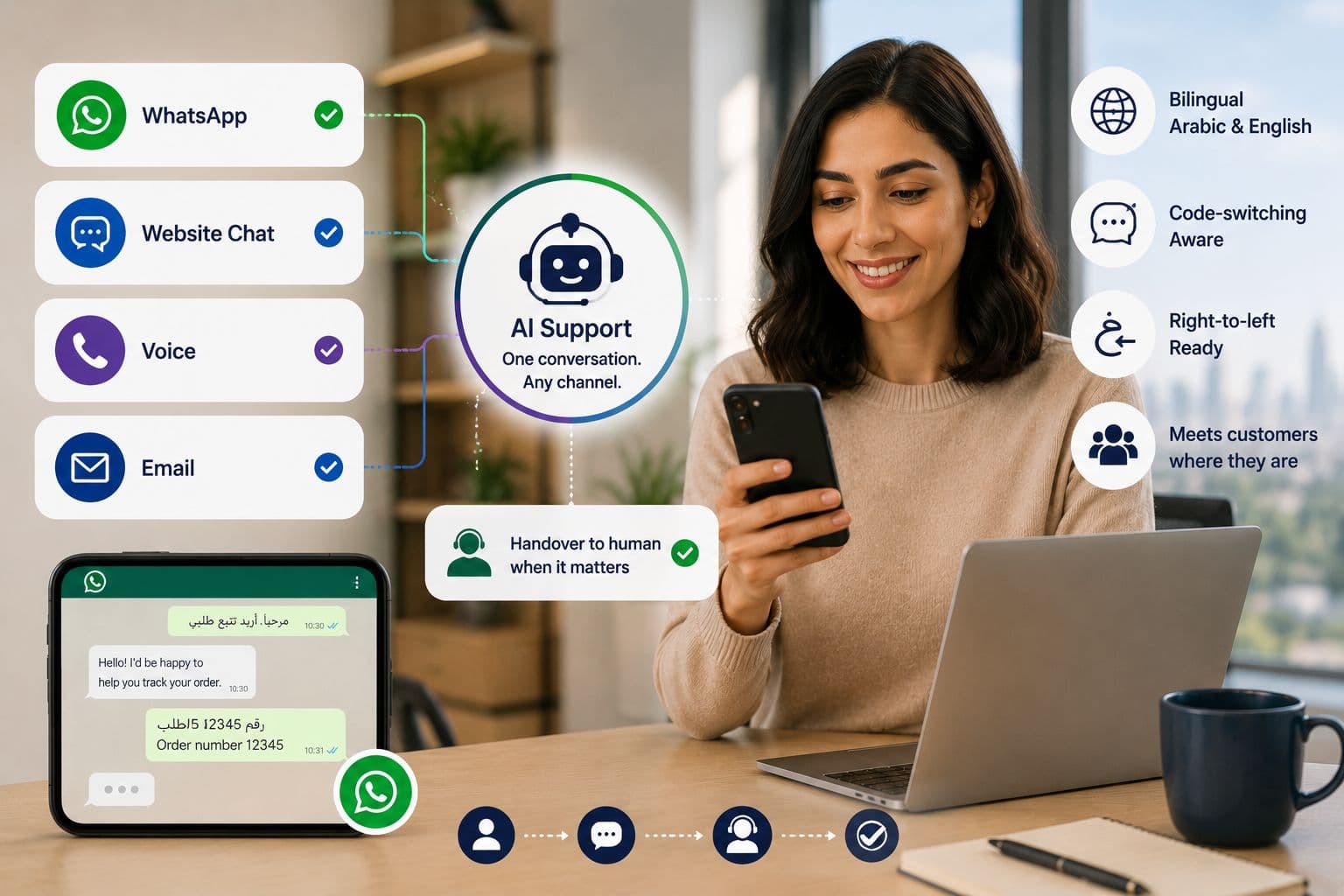
An elastic AI support layer can be fluently bilingual, culturally fluent, and well integrated, and still underperform for a simple reason: it is sitting on the wrong channel. A support layer only absorbs contact volume on the channels customers actually use to make contact. In the GCC, that means thinking carefully about channels, and in particular about WhatsApp.
The website chat widget is not where the customers are
The default assumption in many customer-service deployments is that the AI layer lives in a chat widget on the business's website. The customer visits the site, clicks the widget, and the conversation happens there. For some businesses and some customers, that is fine.
But it embeds an assumption: that the customer will come to the business's own property to make contact. Many customers, in many markets, do not. They contact a business from where they already are, the messaging app already open on their phone, rather than navigating to a website and finding a widget. A support layer confined to the website chat widget is available only to the subset of customers willing to come to the website to use it, and during a demand peak, when contact volume and contact urgency are both high, that subset is not the whole customer base.
WhatsApp in the GCC
In the GCC specifically, WhatsApp occupies a place in everyday communication that makes it central to customer service. It is, for a very large share of the population, the default messaging channel, the natural place to have a conversation, including a conversation with a business. For many GCC customers, contacting a business on WhatsApp is not a special channel choice; it is simply how contacting a business is done.
This means a customer-service strategy for the GCC that does not treat WhatsApp as a primary channel is, in practice, declining to be available where a large part of its customer base naturally looks. An elastic support layer that operates on WhatsApp natively meets those customers in the place they already are. One that does not is asking them to come somewhere else, and at a busy moment, some of them simply will not.
Channels are not all the same
Being on the right channels is not only a matter of presence; it is a matter of fitting each channel's character. A messaging channel like WhatsApp is asynchronous and conversational, a customer may send a message, set the phone down, and return to the reply later, and the conversation can unfold over a stretched period. A website chat tends to be more synchronous, expected to happen in one continuous sitting. Voice is immediate and synchronous. An elastic support layer should behave appropriately for the channel it is on, rather than imposing one channel's interaction model everywhere.
It should also, where a business operates across several channels, maintain continuity, so that a customer's history and context are not lost when a conversation moves from one channel to another, and the customer does not have to start again because they switched from website chat to WhatsApp, or from WhatsApp to a phone call.
Channels and the demand peak
The channel question connects directly to the demand-peak problem. The purpose of the elastic layer is to absorb the surge of routine contacts during a GCC peak. A contact can only be absorbed on a channel the layer is actually on. If, during the Eid surge, a large share of customers reach for WhatsApp, as in the GCC they will, then a layer present only in website chat absorbs only a fraction of the surge it was built to absorb. The rest of the volume still arrives, through WhatsApp, and still has to be handled, which means it either overwhelms the human team or is handled poorly.
An elastic support layer is therefore only as effective as its channel coverage allows. Getting the AI right and then deploying it where customers are not is a way to do most of the work and capture little of the benefit. For a GCC business, meeting customers where they are, with WhatsApp prominent in that picture, is part of what makes an elastic layer genuinely elastic, rather than elastic in theory and absent in practice.