
Artificial intelligence is becoming a practical business decision for organisations across the UAE. For a startup, that decision might involve building an AI-enabled product. For a growing business, it could mean automating enquiries and administrative work. For an enterprise, it often means connecting AI to software that already supports critical operations.
The most useful question is therefore: where can AI improve a specific business process, and what must change to make it reliable?
Recent UAE developments point towards three priorities: agentic AI that can execute tasks, infrastructure designed for greater control over data, and stronger Arabic-language capabilities. Together, these create opportunities for businesses launching new products and those modernising existing applications.
What Is Driving AI Adoption in the UAE in 2026?

Agentic AI is moving into operational workflows
In April 2026, the UAE announced a government framework targeting the transformation of 50% of government sectors, services and operations towards agentic AI within two years. An August workshop advanced the initiative’s strategic workstream. This is a transformation target, rather than a statement that half of government operations are already automated. mediaoffice.ae
Agentic AI refers to systems that can work towards a defined goal by planning steps and using connected tools.
For example, a conventional chatbot might explain how to book an appointment. An appropriately configured AI agent could check availability, create the booking through an authorised integration, and send confirmation.
For private businesses, these government developments signal an emphasis on practical execution. Our assessment is that this makes integration, workflow design and human oversight increasingly valuable parts of UAE technology projects.
Sovereign AI infrastructure is becoming more accessible
In July 2026, e& UAE and Core42 announced a partnership offering sovereign AI compute, designed to give enterprise and government customers access to AI infrastructure while keeping sensitive workloads and data within the UAE. core42.ai
For businesses, this expands the infrastructure choices available when planning AI deployment. The right architecture still depends on the workload, budget, contractual commitments and applicable requirements.
Selecting a local hosting region is one part of that decision. Organisations also need to understand where model processing, backups, logs and connected services operate.
Arabic AI is strengthening regional product opportunities
In January 2026, Abu Dhabi’s Technology Innovation Institute announced Falcon-H1 Arabic, with improvements in Arabic understanding, dialect coverage and contextual reasoning. atrc.gov.ae
This development creates additional options for businesses designing Arabic-language experiences. However, model benchmarks should be followed by testing against real customer questions, industry terminology and bilingual conversations.
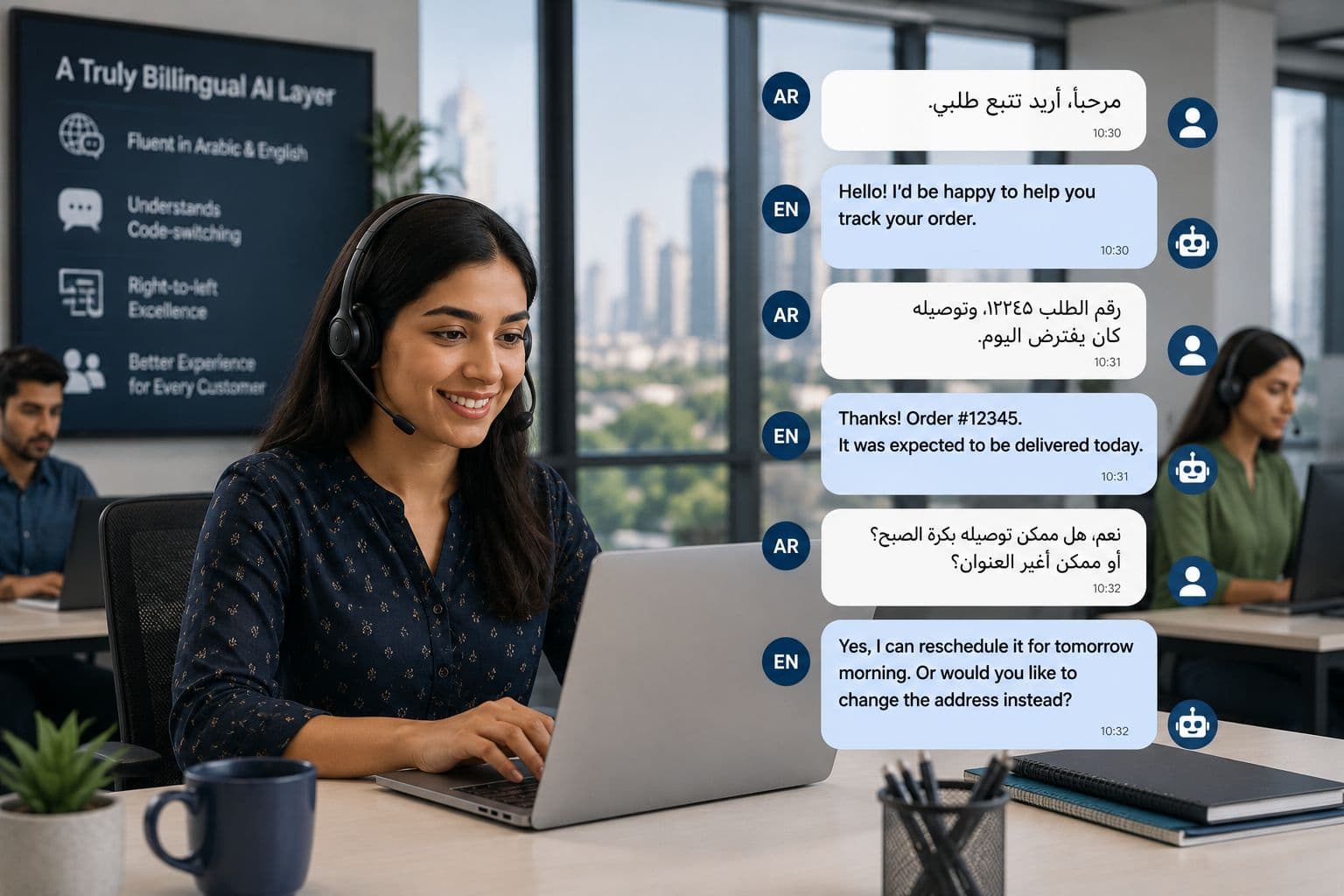
For UAE products, Arabic and English support should be considered during discovery, alongside interface design, knowledge content and service handover.
How These Trends Affect the UAE Tech Industry
These developments suggest that AI delivery requires more than selecting a language model.
A useful business application must connect information, user permissions and operational systems. It must also handle incorrect answers, unavailable services and requests that require human judgement.
This creates opportunities across several areas:
-
Software engineering: building AI features into customer and employee applications.
-
System integration: connecting AI workflows with CRM, ERP and operational platforms.
-
Data engineering: preparing reliable information for search, analysis and automation.
-
Product design: making AI actions understandable and easy to review.
-
Operational support: monitoring quality, costs and failures after deployment.
For technology buyers, the practical implication is straightforward: evaluate an AI solution by the workflow it improves and how reliably it operates.
How Emerging Startups Can Use AI
Startups can incorporate AI early, but should begin with a clearly defined customer problem.
Useful starting points include a property enquiry assistant, document search for professional services, an onboarding copilot, or an AI feature within a specialist software product.
A focused first release makes it easier to test whether customers find the feature useful and whether the business can afford to operate it.
Founders should define:
-
The task the user wants to complete.
-
The information the AI needs.
-
The actions it may perform.
-
The situations that require human support.
-
The cost of serving each successful interaction.
For example, a property platform could initially help users find suitable listings from verified inventory. Booking viewings and updating the sales pipeline could follow once the initial experience is validated.
Mobiloitte’s custom AI software development services provide a relevant starting point for discussing AI-enabled products and business applications.
How Growing Businesses Can Improve Daily Operations
For SMEs and expanding businesses, a practical opportunity is reducing repetitive coordination.
Employees often move information between enquiries, spreadsheets, email and business software. AI can help interpret unstructured requests, while conventional automation handles predictable steps.
An enquiry workflow might:
-
Capture a request from a website or messaging channel.
-
Identify the service required.
-
Check whether essential information is missing.
-
Create or update a CRM record.
-
Assign the enquiry to the appropriate employee.
-
Prepare a response for review.
The business should measure response time, incomplete records, missed follow-ups and staff effort before and after implementation.
For these use cases, AI workflow automation can be evaluated around a specific operational bottleneck.
How Enterprises Can Connect AI With Existing Systems
Enterprises already have substantial investments in ERP, CRM, finance applications and internal platforms. AI needs to work within this environment.
Potential applications include searching approved policies, summarising support histories, preparing procurement requests and assisting employees with operational reporting.
These workflows should respect existing permissions. An employee-facing assistant should only retrieve information that employee is authorised to access.
Actions also need clear boundaries. Drafting a purchase request and approving a payment require different controls.
An illustrative procurement workflow could retrieve an approved supplier record, identify missing documents, prepare a request and route it to a manager. Financial approval would remain within the established authorisation process.
Mobiloitte’s CRM, ERP and system integration services address the connectivity required for this approach.
Can AI Work With Old or Legacy Software?
Yes—where the software can provide sufficiently secure and reliable access to the required data and functions. A complete rebuild is not automatically necessary.
Older applications often contain valuable business rules, historical records and integrations. Modernisation should begin by understanding which parts still serve the organisation well.
Depending on the assessment, businesses can:
-
Add a modern interface to an existing backend.
-
Introduce APIs or controlled integration adapters.
-
Improve data quality and reporting.
-
Add search across approved documents.
-
Replace individual modules in stages.
-
Rebuild components that are unsafe or impractical to maintain.
For example, an established service-management application might continue handling job records while a new assistant helps employees find service history and prepare updates.
If the application lacks APIs, the integration approach needs closer evaluation. Controlled exports or adapters may be suitable; direct database access and interface automation require careful handling.
Mobiloitte’s AI application modernisation services describe a phased approach to evolving existing software while preserving useful business logic and integrations.
Practical AI Opportunities Across UAE Businesses
The following are illustrative use cases, rather than claims of completed deployments.
|
Business area |
Potential AI application |
Measure to track |
|
Real estate |
Bilingual enquiry qualification and viewing coordination |
Response time and completed bookings |
|
Retail |
Product guidance and order-support assistance |
Resolution rate and handover quality |
|
Logistics |
Shipment enquiries and document extraction |
Handling time and extraction errors |
|
Professional services |
Search across approved internal knowledge |
Time spent finding information |
|
Field services |
Service-history summaries and appointment assistance |
Administrative effort and booking accuracy |
|
Enterprise operations |
Document classification and approval preparation |
Processing time and exception rate |
Customer-facing use cases can combine AI agents and chatbots with human handover when a request is sensitive, unclear or outside the system’s scope.
For further reading, explore our article on AI customer service for GCC demand peaks.
How to Start an AI Project With Measurable Value
A useful starting point is one workflow with a clear owner and a measurable problem.
Assess the current process, available data, integration options and consequences of an incorrect action. Then build a limited pilot using representative tasks.
Before expanding, evaluate:
-
Whether answers are accurate and grounded in approved information.
-
Whether permissions are enforced.
-
Whether failures reach the right person.
-
Whether the workflow saves enough effort to justify its operating cost.
-
Whether employees and customers can use it comfortably.
Expansion should follow evidence from the pilot. Some processes benefit from AI interpretation; others are better served by simpler rule-based automation.
How Mobiloitte UAE Can Help
Mobiloitte UAE’s published services cover custom AI applications, workflow automation, conversational assistants, enterprise integrations and application modernisation. These capabilities support discussions around new products and improvements to existing systems. Mobiloitte UAE
For a startup, the discussion can begin with a focused AI-enabled product. For a growing business, it can begin with an operational workflow. For an enterprise, it can begin with integration readiness and a phased modernisation roadmap.
Planning an AI product or looking to improve existing software?
Frequently Asked Questions
What are the main UAE AI trends in 2026?
Recent developments include government-led agentic AI initiatives, sovereign AI infrastructure offerings and advances in Arabic-language models. For businesses, these support opportunities in workflow automation, regional products and enterprise integration.
Can a startup adopt AI without training its own model?
Yes. A startup can evaluate existing models and connect them to its product and approved knowledge. Training a custom model should depend on a demonstrated requirement.
Can AI integrate with an existing CRM or ERP?
Yes, provided suitable integration methods and permissions are available. The implementation should preserve access controls, approval rules and data consistency.
Does legacy software need to be completely rebuilt?
Not always. An assessment may recommend integration, selective upgrades or phased replacement. A rebuild becomes appropriate when existing limitations make continued operation impractical.
How should a business measure AI project success?
Track the outcome of the selected workflow, including accuracy, completion time, operating cost, user adoption and the quality of human handovers.